Pencarian berdasarkan :
Pencarian terakhir:
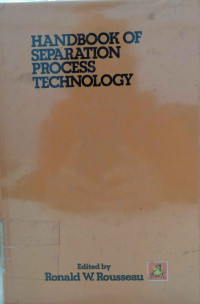
— Ronald W. Rousseau - Nama Orang;
The "Handbook of Separation Process Technology," edited by Ronald W. Rousseau, is a comprehensive resource that surveys the selection, design, and operation of industrially significant separation processes.
Part I: General Principles
- Phase Equilibria: Discusses the balance between different phases in a system, essential for understanding separation processes.
- Mass Transfer Principles: Explores the movement of mass within chemical processes, a fundamental aspect of separation technology.
- Phase Segregation: Covers the separation of different phases within a mixture, crucial for effective separation.
- General Processing Considerations: Addresses overarching factors and strategies in designing and operating separation processes.
Part II: Individual Separation Processes
- Distillation: Examines the process of separating components based on differences in boiling points.
- Absorption and Stripping: Focuses on techniques where a component is transferred from one phase to another.
- Extraction—Organic Chemicals Processing: Discusses the separation of organic compounds using solvent extraction methods.
- Extraction—Metals Processing: Covers techniques for extracting metals from ores or solutions.
- Leaching—Metals Applications: Explores the process of extracting metals from solid materials by dissolving them in a liquid.
- Leaching—Organic Materials: Addresses the extraction of organic compounds from solids using liquid solvents.
- Crystallization Operations: Details the formation of solid crystals from a homogeneous solution.
- Adsorption: Explores the adhesion of atoms, ions, or molecules from a gas, liquid, or dissolved solid to a surface.
- Ion Exchange: Discusses the exchange of ions between a solution and an ion exchange material.
- Large-Scale Chromatography: Covers techniques for separating mixtures based on differential partitioning between mobile and stationary phases.
- Separation Processes Based on Reversible Chemical Complexation: Examines methods where separation is achieved through reversible chemical reactions.
- Bubble and Foam Separations—Ore Flotation: Discusses the use of bubbles to separate valuable minerals from ore.
- Bubble and Foam Separations—Waste Treatment: Explores the application of foam separation techniques in treating waste.
- Ultrafiltration and Reverse Osmosis: Covers membrane-based separation processes for filtering and purifying liquids.
- Recent Advances in Liquid Membrane Technology: Highlights new developments in using liquid membranes for separation.
- Separation of Gaseous Mixtures Using Polymer Membranes: Discusses the use of polymer membranes to separate gas mixtures.
- Membrane Processes—Dialysis and Electrodialysis: Explores membrane-based processes for separating solutes based on their diffusion rates.
- Selection of a Separation Process: Provides guidance on choosing the appropriate separation technique for a given application.
Each chapter delves into the underlying principles of these processes and provides illustrative examples of their application in modern contexts.
Ketersediaan
| 2020907785-1 | REF 660.284 HAN h C/1 | Perpustakaan Pusat (Koleksi Referensi) | Tersedia namun tidak untuk dipinjamkan - Tersedia (Tidak Dipinjamkan) |

